Tree Removal FAQ — Poplar Bluff, MO
Answers to the questions Poplar Bluff property owners ask most about tree removal, storm cleanup, and everything around it. If a tree is already down or already leaning on something, skip ahead and tell us what is going on.
How much does tree removal cost in Poplar Bluff?
It depends mostly on size and difficulty, but typically small trees under about 30 feet run toward the lower end, medium trees between 30 and 60 feet cost more, and large or hazardous trees — over 60 feet, or leaning on a structure — cost the most. National ranges for tree removal typically run from a few hundred dollars for a small, easy tree up to a few thousand for a large tree in a tough spot. Access, lean direction, and what is nearby all move the number more than height alone. A real number comes after someone actually looks at the tree.
What makes one tree removal cost more than another?
Size is the starting point, but it is not the only factor. A tree with clear drop room in an open yard is a simpler job than the same size tree wedged between a house, a fence, and a power line, where every piece has to be lowered by rope instead of dropped whole. Rotten or hollow wood changes the approach and the time it takes. Stump grinding, if you want it, is typically priced separately from removal. Hauling debris off-site instead of leaving it stacked also adds to the total.
Who owns a tree on the property line?
A tree whose trunk sits on or straddles a boundary line is generally treated as jointly owned by both property owners under Missouri law, which usually means neither owner can remove it without the other's agreement. A tree growing entirely on one side of the line, even if branches or roots cross into a neighbor's yard, typically belongs to the property it is rooted on — though the neighbor generally has the right to trim back what crosses onto their side. Boundary-line tree disputes get complicated fast, and a property survey is often the only way to know for certain where a trunk actually sits.
Does homeowners insurance cover tree removal after a storm?
Often, but with conditions. If a storm drops a tree on your house, garage, fence, or another insured structure, most homeowners policies typically cover removing the part that caused the damage, along with repairs. If a tree falls in the yard and does not hit anything insured, many policies do not cover removal at all — it gets treated as routine yard maintenance. Coverage details vary by carrier and policy, so check your specific policy or ask your agent before assuming either way, and photograph the damage before anything gets moved or cut up.
Do I need a permit to remove a tree in Poplar Bluff?
For most residential trees on private property, typically no permit is required. Rules can differ for trees in a designated right-of-way, near a street or utility easement, or in a subdivision with its own covenants, so it is worth a quick check with the city or your HOA if the tree sits anywhere near a property line, street, or easement. Land clearing on larger tracts, especially near waterways or in a floodplain, is more likely to involve local or state rules — worth confirming before equipment shows up.
What's the difference between stump grinding and stump removal?
Stump grinding chews the stump and surface roots down below grade using a grinding wheel, leaving wood chips behind and a stump you can cover with soil and grass seed. It is typically faster, less disruptive to the surrounding yard, and typically costs less. Stump removal pulls the entire stump and root ball out of the ground, which leaves a bigger hole to fill but clears the ground completely — useful if you are planting another tree in the same spot or need the root system gone for construction. For most yards, grinding is the more practical and more common choice.
Should I have this tree trimmed, or does it need to come down?
If the tree is structurally sound — solid wood, no major cavities, no significant lean toward a structure — trimming is usually the better call. Deadwood, low limbs over the roof, and canopy that has gotten too dense can all be addressed without removing the whole tree. Removal becomes the answer when the tree is dead, has significant trunk decay, is leaning toward a structure with a compromised root system, or has damage trimming cannot fix. When it is not obvious which category a tree falls into, that is exactly the kind of thing worth having someone look at in person rather than guessing from the ground.
What happens if a tree is touching or near a power line?
Stop and treat it differently. Trees in contact with power lines are not a homeowner job or a general tree-crew job — the utility company has to be involved first, because the line may be energized and the tree itself can conduct electricity. If a storm has put a tree on a line, or a line is running through a tree's canopy, contact the utility before anyone touches the tree. Once the line question is resolved, tree work can proceed normally.
Can I remove a tree myself?
Small, low, open-area trees with a clear fall path — maybe, if you have the right equipment and know how to read a lean. Anything larger, anything near a structure, fence, or line, or anything that requires climbing or a ladder is a different situation. A chainsaw at height, a trunk under tension, or a lean that is not what it looks like from the ground are exactly the conditions behind serious injuries every year. If there is any real doubt about which direction a tree will fall, that doubt is the answer.
How do I know if a tree is dead or just dormant?
In season, a live tree pushes leaf buds; a dead one stays bare while everything around it leafs out. Bark that peels away easily to reveal dry, brittle wood underneath, rather than green, moist wood, is a sign of a dead limb or trunk section. Mushrooms or fungus growing at the base often point to root or trunk decay. A trunk that sounds hollow when tapped, or a lean that has visibly increased, are both worth taking seriously. When more than half the canopy stays bare during the growing season, the tree is usually past saving.
What should I do first after a storm drops a tree on my property?
Check that everyone is safe and stay away from anything touching a power line — treat every downed line as live until the utility says otherwise. Photograph the damage before anything is moved, for insurance purposes. If it is safe to do so, keep people, pets, and vehicles clear of the area until the tree or limb is stabilized or removed, since storm-damaged wood can shift or drop further without warning. Then get it looked at — a tree resting on a structure after a storm is not something to leave for later.
Do you handle emergencies, including nights and weekends?
Storms do not check a calendar before they hit, so reach out any time it happens — day, night, weekend, or holiday. A tree resting on a roof or blocking a driveway at midnight gets the same attention as one reported at noon. The one thing worth avoiding is waiting until morning to "see how bad it is" when a tree is already unstable — an unstable tree does not usually get safer overnight.
Will removing a tree tear up my yard?
Some disturbance is normal — dragging brush, positioning equipment, and lowering large sections all leave marks, especially in wet ground. A crew working a residential yard typically routes equipment and drop zones to limit damage to grass, beds, and driveways where possible, and ruts or bare patches from necessary equipment usually recover on their own or with a little reseeding. A job done in the middle of a wet spring leaves more mark than the same job done on dry ground, which is sometimes a reason to wait a few days if the tree is not urgent.
What happens to the wood and debris after a tree comes down?
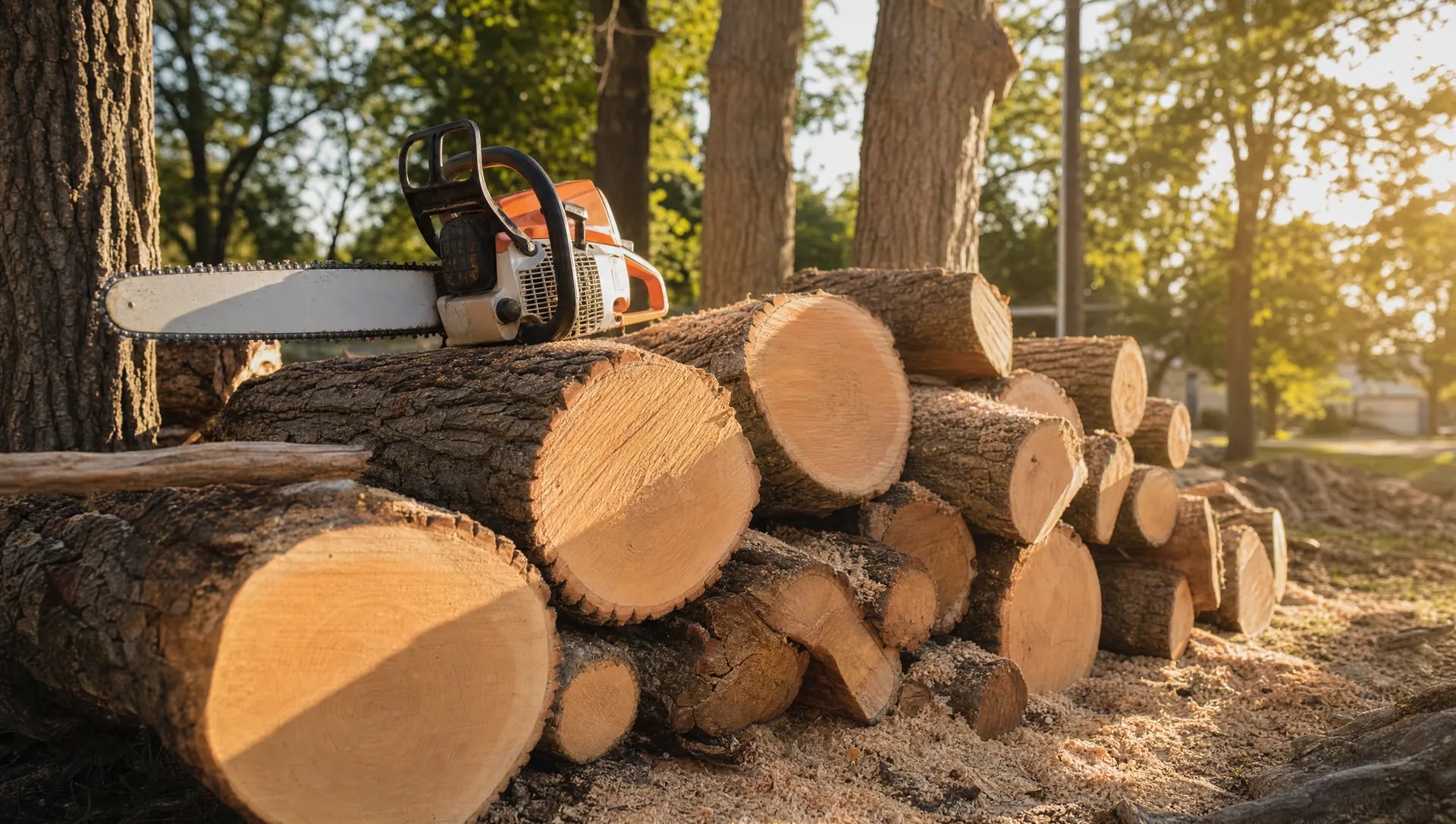
That is usually the property owner's call. Some people want the wood cut into rounds and left for firewood, some want everything hauled off, and some want the stump ground and the whole area cleaned up like the tree was never there. Brush and small limbs typically get chipped or hauled away; larger trunk sections can be cut to length and left, split for firewood, or removed, depending on what you would rather deal with. Worth deciding before the job starts, since it changes the time involved and sometimes the cost.
Get Help Now
If you have a tree down, a hazardous lean, or storm damage that needs attention, tell us what is going on and we will get you connected with tree work in the Poplar Bluff area.
Need Help in Poplar Bluff Right Now?
Tell us what you need and we'll get back to you fast with a free, no-pressure quote.